








Engineering Creativity for Neuroscience
Temperature Management in Physiology and Biology
Physiological - Biological Temperature Controller TMP-5x
The central element of every temperature control process is the temperature controller. You can see the detailed description of the TMP-5x temperature controller on the Animal Temperature Control page, because we do not want to publish the same content twice on our website.
Precision Biological Temperature Meter BTM-4a
Temperature Meter is a very useful equipment, because:
• It can be calibrated by the user to achieve an infinite level of accuracy. Its precision depends only on the master-gauge involved.
• It has an analog voltage output for high resolution measurement and data logging on any 3rd-party DAQ device.
• It employs industrial standard Pt100 sensors. This way any special thermal connection can be designed and constructed.
We offer tailored sensors, but a custom shaped Pt100 can be used to measure the temperature of special objects.
Precision Biological Temperature Meter BTM-4a is a high accuracy temperature meter optimized for the temperature range of living tissues. The resolution of the measurement is 0.1 Centigrade and the accuracy of the Biological Temperature Meter can be trimmed as accurate as your temperature reference used for calibration.
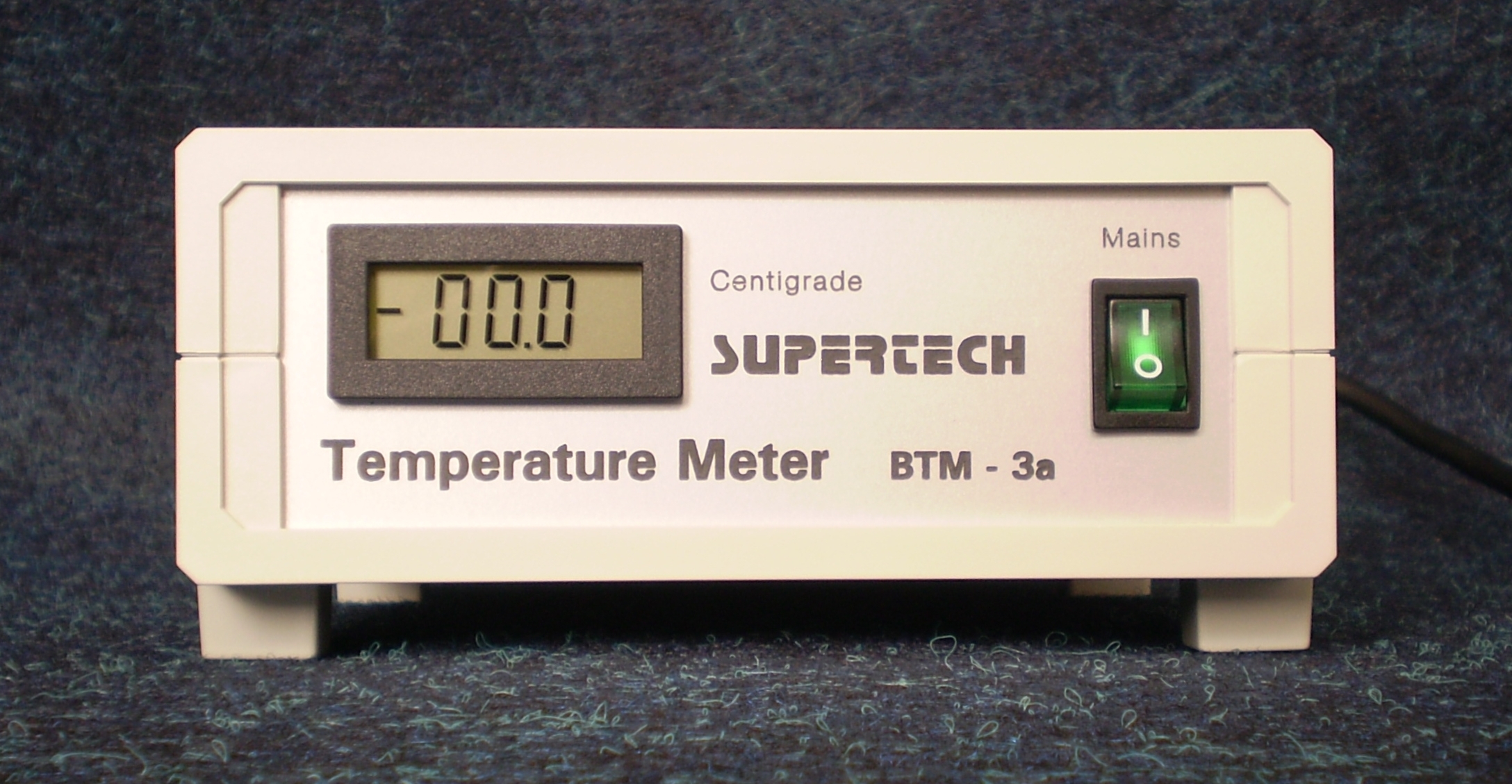
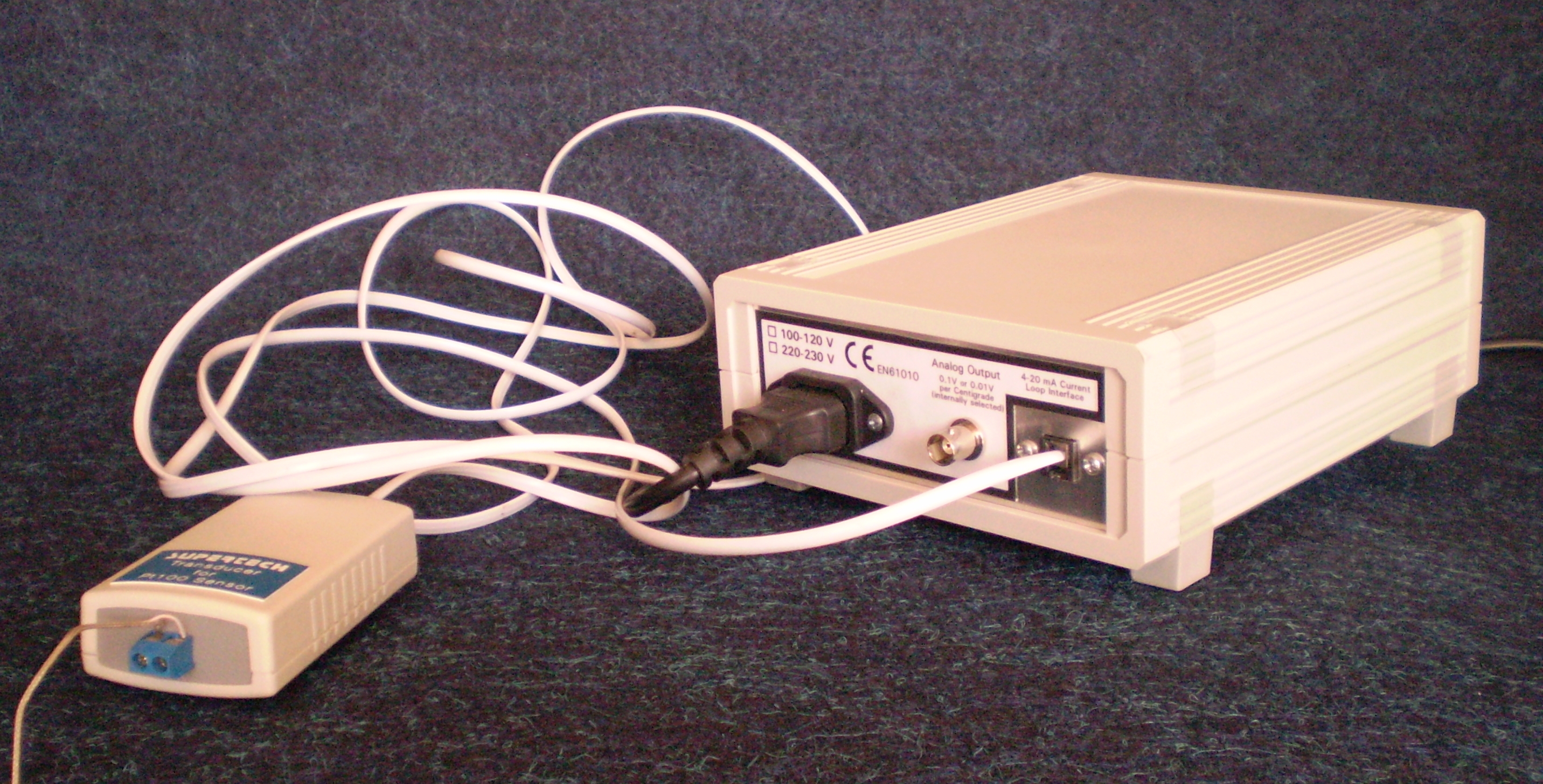 Click on the picture to get it in full size
The Biological Temperature Meter has a crucial, compulsory accessory, the Pt100 Transducer Box. It is a small piece of equipment in a plastic enclosure. The Pt100 Transducer Box is to be positioned very close to the Pt100 sensor. The cable length of the Pt100 sensor must be reduced as much as possible to keep the electric noise level at a minimum (not to interfere with the temperature measurement). The Biological Temperature Meter and the Pt100 Transducer Box are connected by a 1.6 meter long wire that is not sensitive for disturbing electromagnetic fields. The Pt100 Transducer Box is designed to accept any kind of Pt100 sensor. This feature provides the possibility of choosing that sensor, which optimally fits the experimental environment. The only limitation is that the chosen sensor must be Pt100 type. The size, shape and enclosure of the sensor can be chosen freely.
Two versions of the Pt100 Transducer Box:
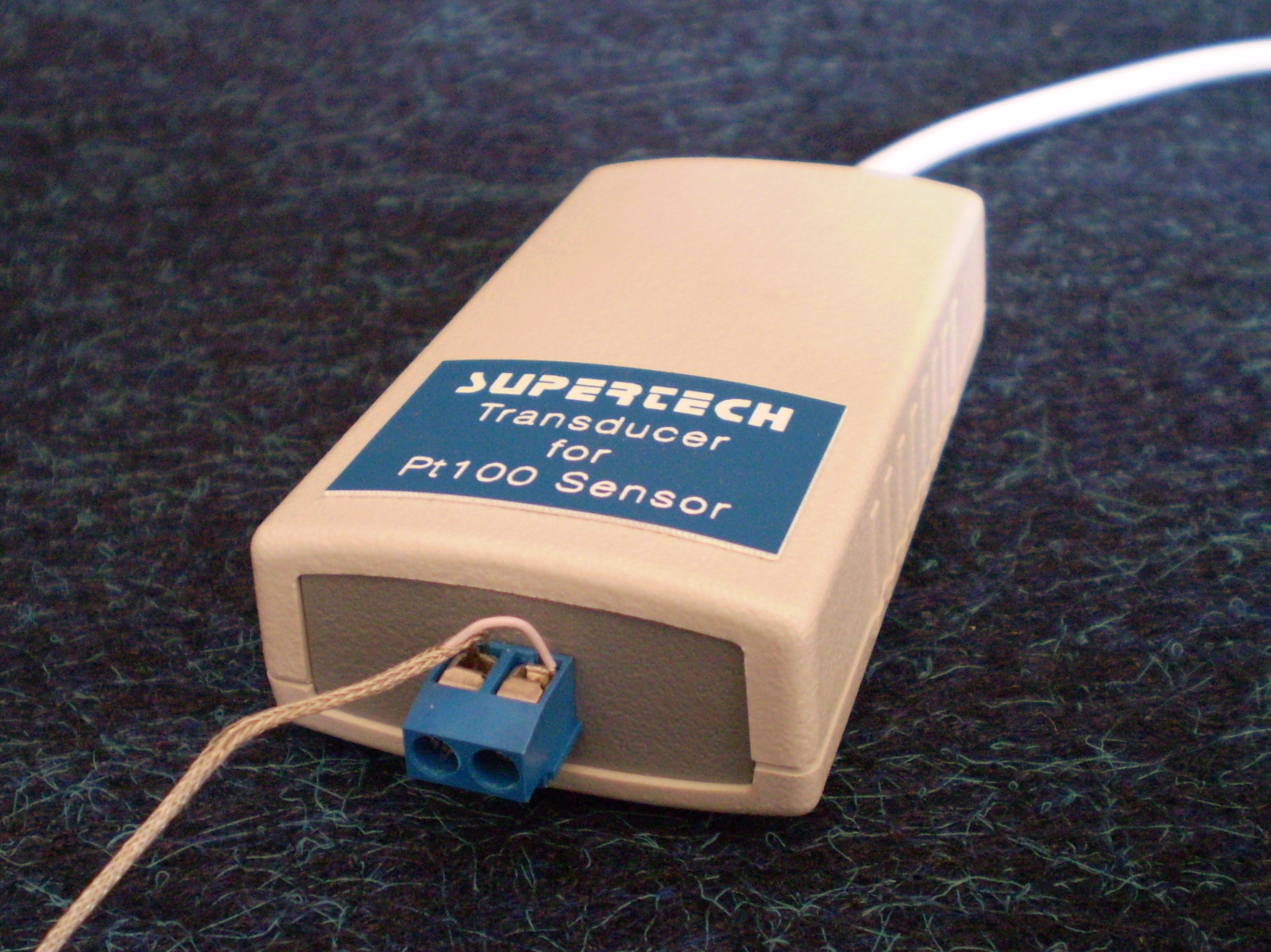
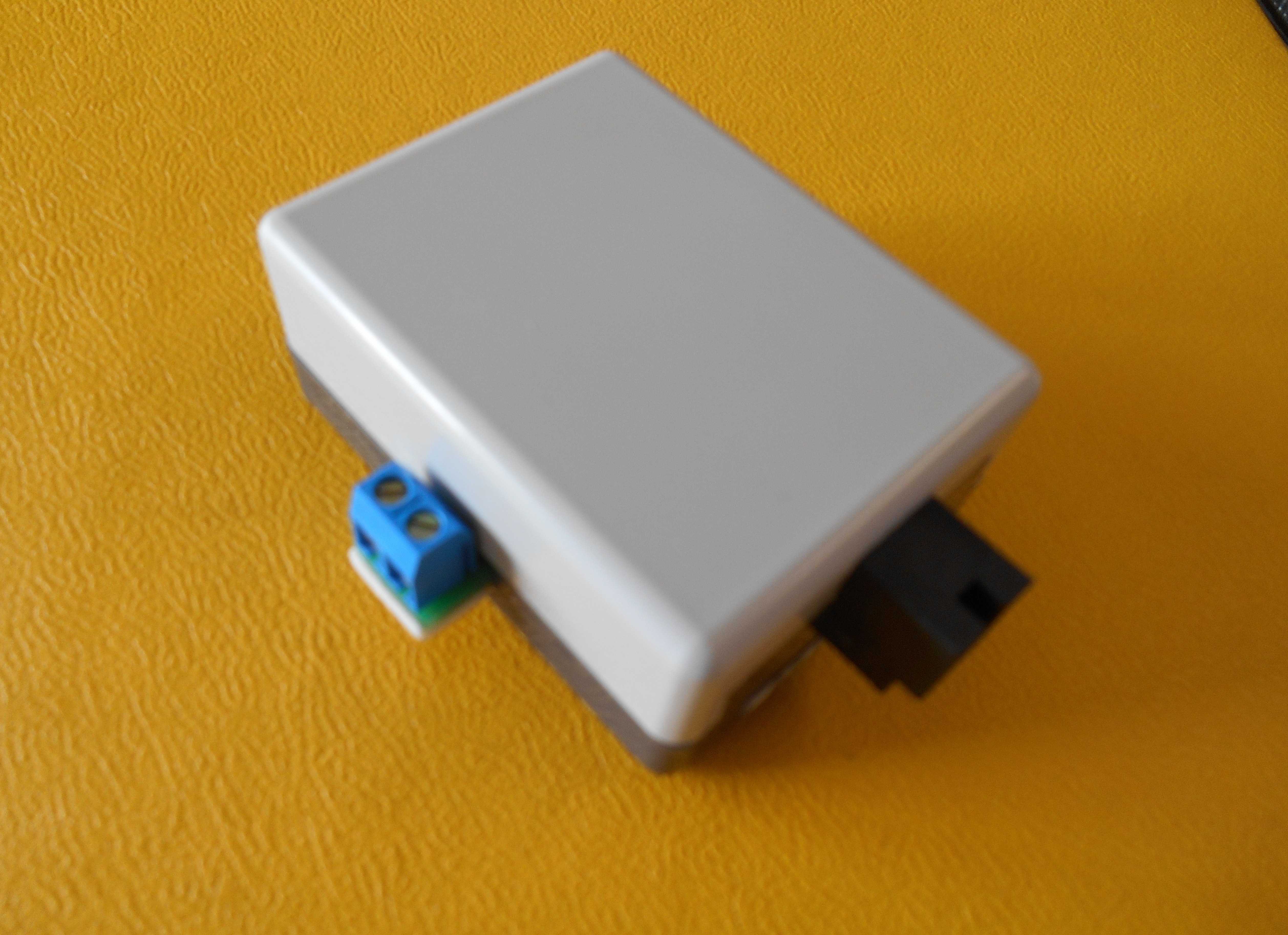 Click on the picture to get it in full size
There are two internal potentiometers built into the Pt100 Transducer Box, "Gain" and "Shift". Using these potentiometers the error of the temperature measurement can be trimmed to absolute zero. It is always necessary to adjust these potentiometers after changing the sensor, because commercial sensors have quite high tolerances. This tolerance can be trimmed to zero. The accuracy of your measurement depends only on the precision of your temperature reference used to calibrate the Pt100 Transducer Box. The price of the first Pt100 Transducer Box is included in the price of the Biological Temperature Meter.
The Pt100 sensor is neither included in the price of the Precision Biological Temperature Meter BTM-3a, nor in that of the Pt100 Transducer Box. To use the Temperature Meter, a Pt100 sensor should be ordered from our selection, or from any 3-rd party manufacturer.
Specifications / Technical Data
Measured temperature range: - 40 Centigrade to 120 Centigrade
Resolution of the measurement: 0.1 Centigrade
Display: 3.5 characters numeric LCD with backlight
Analog voltage output for PC-based DAQ systems: 0.1 V or 0.01 V per Centigrade (jumper selectable)
Temperature sensor: Pt100
Dimensions of the Biological Temperature Meter: 200 x 160 x 75 mm
Dimensions of the Pt100 Transducer Box: 90 x 50 x 25 mm
Mains voltage: 100-120V or 220-230V (chosen by an internal selector switch, fixed in the factory)
Power consumption: 30 VA
Weight: 1.8 kg
The complete User Manual of the Precision Biological Temperature Meter is available for download.
Temperature Sensors
• Pt100 temperature sensor with stainless steel coating TS-Pt100-1 : compatible with the Precision Biological Temperature Meter BTM-xx
Main features:
- Diameter: 3.0 mm, it can be used as rectal sensor for rats (and maybe mice)
- Regular user calibration is needed for high accuracy
- Relatively strong and durable
- It is shielded. The outer tube can be connected to GND.
• Pt100 temperature sensor with epoxy coating TS-Pt100-2 : compatible with the Precision Biological Temperature Meter BTM-xx
Main features:
- Diameter: 2.6 mm, it can be used as rectal sensor for rats (and maybe mice)
- Regular user calibration is needed for high accuracy
- Vulnerable, careful handling is required
- It is not shielded
• Pt100 miniature temperature sensor TS-Pt100-3 : compatible with the Precision Biological Temperature Meter BTM-xx
Main features (preliminary info, available soon):
- Diameter: 0.9 mm, it can be used as rectal sensor for mice
- Length: 15 mm (excluding connector wire)
- Regular user calibration is needed for high accuracy
- Vulnerable, careful handling is required
- It is not shielded
• DS18S20 temperature sensor TS-DS18S20 : compatible with the Physiological - Biological Temperature Controller TMP-xx
You can see its description on the Animal Temperature Control page.
Custom Size Heating Plates
Custom size heating plates can be ordered for special applications. The thickness of the custom size heating plates vary between 12 mm and 20 mm, depending on the actual size. Custom size heating plates are multilayer constructions. The top layer is a thin stainless steel plate, followed by a thick aluminum plate. The third (bottom) layer is a heat-insulating plastic plate. The thickness of the aluminum plate (middle layer) can not be decreased too much because it contains electronic circuits. There are active electronic heat generators used as heating elements in the heating plates. The heat generators are realized by electronic circuits (transistors, diodes and resistors). The heating plates are covered by stainless steel by default. Anodized aluminum top is available upon request.
Special Heaters and Unique Heated Equipments
On the one hand our Physiological - Biological Temperature Controller TMP-xx device, thanks to its different power end-stages, is an extremely versatile temperature controller. It can manage every temperature regulation task in life science. Only the task-specific "thermal interface" is needed. On the other hand our design engineers have several decades of experience in the field of temperature control, as we have developed many unique heating devices. These facts ensure that we can solve any special task in temperature management for biology and physiology. If you have any special request please do not hesitate to contact us. We will provide a great solution quickly, at a reasonable price. The equipment described in the following paragraph is an example. Originally the first piece was developed for a specific tasks. Later, during design procedures of similar equipments, we decided to introduce it as a standard product.
Heater for Microscope Stage
Heaters for microscope stages are custom-designed products. We can design any special heater pad for you. We design it together with you, according to your special considerations and requirements. The price is fixed in advance as a unit-price, because the different versions are similar to each other either in material or in labor cost. This way we do not deal with nitpicking of price elements. Instead we can focus on the professional aspects of the fast design process.
Usually the heaters for microscope stages are black, hard-anodized aluminum plates, with a thickness of 10 or 12 mm. They can also come with a matte (unglazed) finish. The aluminum provides great durability and rigidity. Openings on the heaters for microscope stages can be covered with a thick glass plate or without glass depending on the actual requirements.
In beginning of the discussion phase we provide a schematic design proposal based on the drawing of the stage and other aspects provided by the customer.
An example:
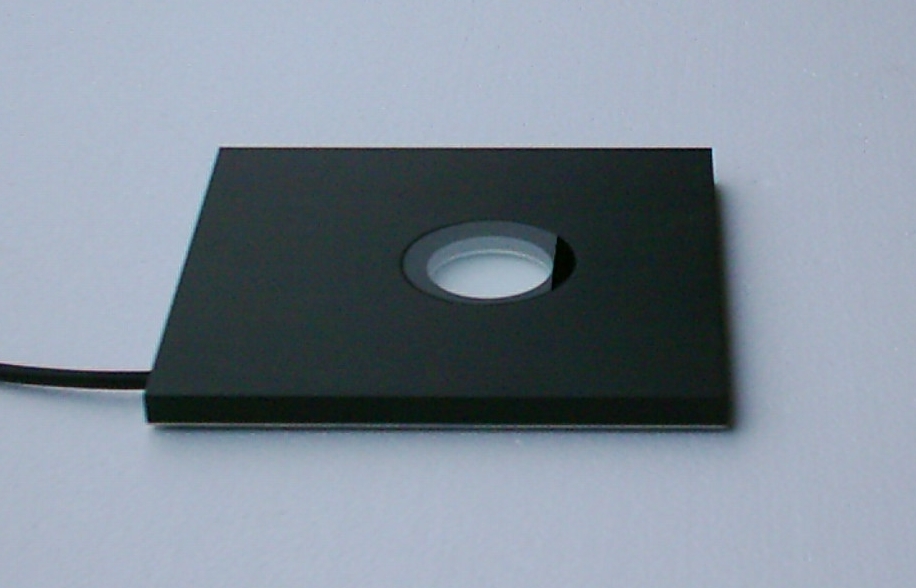 Click on the picture to get it in full size
In the picture you can see a rectangle shaped heater. This model includes the thick glass cover. This style of heater is suitable only for upright microscopes.
Microscope stage heaters can also be round or elliptic shaped. The outer measures, the aperture, the nest of the chamber (if necessary), and the height of the focus plane can be specified by the customer. The only limitation is that we have to take the space for the built-in heater elements into consideration. We use active electronic heat generators as heating elements. The heat generators are located around the opening on the top or bottom side of the heater plate.
The temperature variation between any two points of the metal part of the heater is usually not more than 1 Centigrade (in worst case).
Heaters for microscope stages are equipped with internal temperature sensors. It is recommended to use them instead of external temperature sensors. Please see the explanation of the advantages of the internal temperature sensors on the Animal Temperature Control page.
To use a heater for microscope stage you should buy a Physiological - Biological Temperature Controller assembled with 12V FINE DC or 24V DC power end-stage (the type of the end-stage depends on the actual design).
Prices
You can find the general warranty and shipping conditions in the beginning of the Services page.
SMALL SIZED (smaller than 5 dm2) CUSTOM Size Heating Plate, with built-in digital DS18S20 temperature sensor (compatible with the 12V or with the 24V Physiological - Biological Temperature Controller). Their thickness is 12 mm or more, depending on the actual size, excluding the small rubber feet. Smaller thicknesses are to be discussed before placing an order: 192 EUR / dm2
LARGE SIZED (larger than 5 dm2) CUSTOM Size Heating Plate, with built-in digital DS18S20 temperature sensor (compatible with the 12V or with the 24V Physiological - Biological Temperature Controller). Their thickness is 12 mm or more, depending on the actual size, excluding the small rubber feet: 96 EUR / dm2
SPECIAL OFFER! Design work of unique, custom size heating plates according to your specification and requirements: FREE
Flat heating plate for stage of microscopes, with built-in digital DS18S20 temperature sensor FHP-1 (compatible with the 12V Physiological - Biological Temperature Controller). Unit price, independently of the size: 444 EUR
SPECIAL OFFER! Design work of unique heater plate for microscope stage according to your specification and requirements: FREE
Screw attachable heater assembly, in the power range of 1 to 36 W, with transistor based active heating circuitry, with built-in digital DS18S20 temperature sensor SAHA-1 (compatible with the 12V Physiological - Biological Temperature Controller): 156 EUR
Precision Biological Temperature Meter BTM-4a, compatible with any Pt100 temperature sensor (including the Pt100 Transducer Box): 420 EUR
Replacement Pt100 Transducer Box TB-1: 162 EUR
Pt100 temperature sensor with stainless steel coating and 0.5 m cable TS-Pt100-1: 144 EUR
Pt100 temperature sensor with epoxy coating and 0.5 m cable TS-Pt100-2: 42 EUR
Pt100 miniature temperature sensor with 0.5 m cable TS-Pt100-3: 216 EUR

Copyright @ Supertech Instruments - since 1991